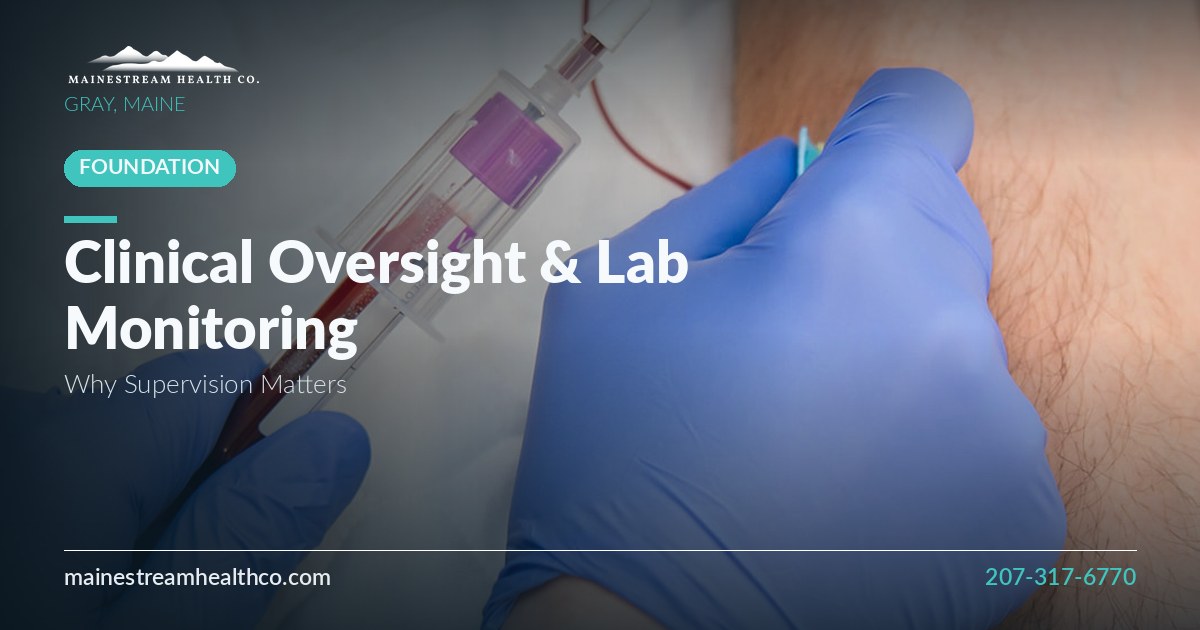
The single biggest difference between peptide therapy that helps and peptide therapy that's a gamble comes down to one word: oversight. Peptides are potent signaling molecules. Used with a provider's guidance and appropriate monitoring, they can be valuable tools. Used blindly — no evaluation, no labs, no follow-up — you're guessing with your physiology. At Mainestream Health, oversight isn't a feature we added — supervised peptide therapy is the whole model.
Why supervised peptide therapy matters
The internet has made it easy to obtain almost anything, and peptides are no exception. But easy access isn't the same as good care. When there's no provider evaluating whether a peptide fits your situation, no baseline picture of your health, and no one watching how you respond, several things can go wrong:
- The peptide may be the wrong tool for your actual goal or underlying issue.
- Dosing may be off, and no one notices.
- Real problems — including ones that have nothing to do with peptides — go unexamined.
- Therapy continues indefinitely with no one asking whether it's still helping.
None of that is peptides "not working." It's peptides used without a framework.
What clinical oversight actually provides
Oversight means a qualified provider is responsible for your plan from start to finish. That includes deciding whether a peptide is appropriate, determining the protocol, and staying involved to adjust it. It also means someone is looking at the whole picture — your history, your other care, your goals — rather than a single symptom in isolation.
At Mainestream Health, that oversight is layered on top of an integrated practice. Your peptide plan can be coordinated with chiropractic care, acupuncture, functional medicine, and hormone therapy, so the pieces work together instead of at cross-purposes.
Where lab monitoring fits
Not every plan requires the same testing, but lab work is one of the most useful tools we have for using peptides responsibly. Appropriate labs can help establish a baseline, inform dosing, and show us how your body is actually responding rather than relying on guesswork or how you happen to feel on a given day.
Monitoring also tells us when to stop or adjust. That's a feature, not a nuisance. We don't believe peptides should be run endlessly on autopilot, and objective data helps us make that call with you.
Restraint is a form of expertise
It's worth saying plainly: knowing when not to use a peptide, or when to pause one, is as much a part of good care as knowing when to start. High-volume sellers have no incentive to ever tell you to stop. A clinical practice does — because the goal is your outcome, not your recurring order.
The bottom line
Supervised, lab-informed peptide therapy is simply better medicine than unmonitored use. It's safer, it's more likely to actually help, and it respects the fact that you're a person, not a subscription.
Contact or call our Gray, Maine office to talk with our team: 207-317-6770. More at mainestreamhealthco.com.
This article is for general educational purposes and is not medical advice. Peptide therapy requires provider evaluation and appropriate monitoring; individual results vary.