Ask ten people what a chiropractor does and you'll get ten answers, most of them some version of "cracks your back." That's a little like saying a surgeon "uses knives." It describes the motion and misses the entire point.
At Mainestream Health Co. in Gray, Maine, we practice Gonstead chiropractic — a specific, rigorously analytical system developed by Clarence Gonstead over a career spent obsessing about one question: which segment, exactly, is the problem? It is not the most common approach in the profession. By our count there are roughly 500 Gonstead practitioners in the world. This guide explains what it is, how it works, and why the difference matters to you.
A healthy spine is a prerequisite to a healthy life
That's the line we lead with, and we mean it structurally, not poetically. Your spine is the mechanical scaffolding your body is built around and the protective housing for the nervous system that regulates everything else. When a vertebral segment loses its normal position and motion, the effects aren't confined to that spot. Mechanics change above and below it. Local tissue gets irritated. Nerve function in that region can be affected.
Gonstead care is built to find that specific segment — and only that segment — and correct it.
The five pillars of the Gonstead exam
This is the part that genuinely separates Gonstead from most of what's practiced. Every Gonstead analysis rests on five distinct lines of evidence, and we don't act until they agree.
1. Visualization
Before we touch you, we watch you. Gait, posture, shoulder and hip height, how you get out of a chair, how you turn your head, skin changes over a region. The body advertises dysfunction constantly, and the earliest signs are visual.
2. Instrumentation
We use a Nervoscope — a dual-probe instrument that runs along the spine measuring temperature differentials between the left and right sides of each segment. Nerve irritation tends to produce a measurable asymmetry in skin temperature. This gives us an objective reading that doesn't depend on anyone's opinion, including mine.
3. Palpation
Two kinds, and both matter. Static palpation assesses tissue tone, tenderness, swelling, and the position of bony landmarks. Motion palpation assesses how each segment moves — and critically, we do it in a weight-bearing position. A spine lying face-down on a table is not the spine that has to carry you through your day. Testing it under load is how you find the true segment of dysfunction rather than a segment that merely feels stiff.
4. X-ray analysis
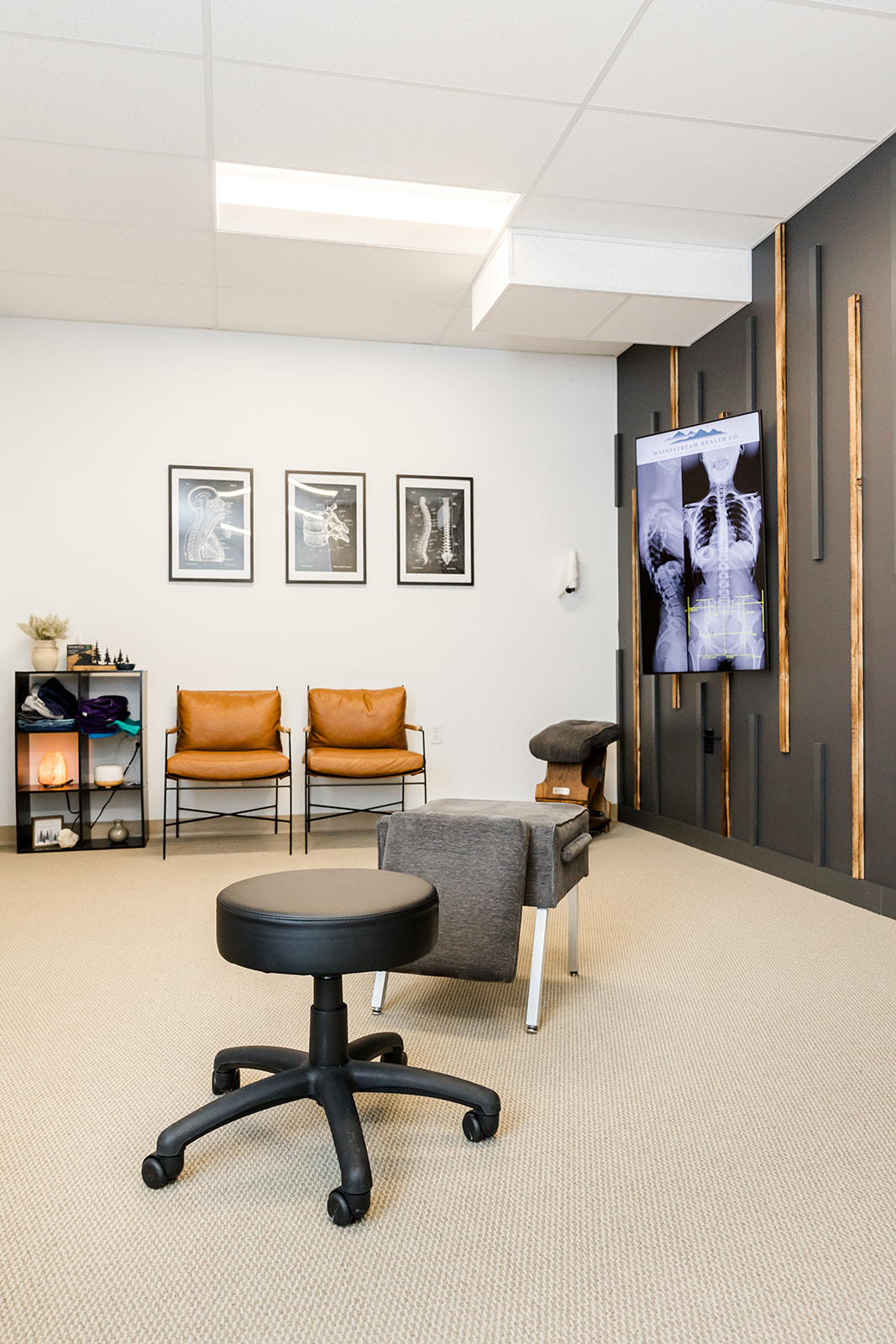
We take full-spine, weight-bearing x-rays and analyze them ourselves. Not to look for something scary — though occasionally we find it — but to measure. Disc height. Vertebral position and angle. Degenerative change. Structural anomalies you'd never find with hands alone. Duration and severity of a problem are written into the film.
Our position on this is simple: we don't guess — we measure. Adjusting a spine you haven't imaged is like a contractor framing a house without ever looking behind the drywall.
5. Case management
Here's the pillar most people never hear about, and it may be the most important. You get a full exam every visit. Not a "how are you feeling today" and a template adjustment. Instrumentation, palpation, and reassessment, every time.
Why? Because your spine is different today than it was on Tuesday. If the segment that needed work last visit is holding, adjusting it again isn't just unnecessary — it's counterproductive. Finding out requires actually checking. No assumptions, no template adjustments.
Specific adjusting: less is more
Because the analysis is specific, the correction can be specific. A Gonstead adjustment is delivered by hand to a single segment, in a particular direction, based on a listing derived from all five pillars. We are not trying to move six joints and hope one of them was the right one.
Patients who've had other kinds of care often notice this immediately: fewer joints move, fewer sounds happen, and the visit feels more deliberate. That's the intent. The goal isn't the number of segments that pop. It's whether the right one was corrected.
What we see in the Gray and New Gloucester area
Our patient list looks like our town: construction and trades workers, loggers, nurses, teachers, people who sit at a desk for nine hours, high school and college athletes, retirees, pregnant patients, and kids. The demands are wildly different, the analytical standard is identical.
Common presentations we work with include:
Spinal: disc injuries, radicular symptoms, sciatica, nerve pain, neuropathies, headaches and migraine patterns, arthritic change, and vertebral compression fractures.
Extremity: shoulder injuries, elbow pain, carpal tunnel patterns, hip and groin pain, knee injuries, ankle sprains, and TMJ. Gonstead doctors are trained in extremity adjusting, and a surprising number of stubborn extremity problems have a spinal component driving them.
The five phases of spinal degeneration
One of the more useful things a weight-bearing film shows us is where you are in a progression that most spines follow if left alone:
- Normal — healthy disc height, alignment, and motion.
- Subluxation complex — a segment has lost normal position and motion; tissue changes begin.
- Disc degeneration — the disc begins to lose height and hydration.
- Bone deformation — the body lays down bone in response to abnormal stress.
- Advanced degeneration — significant structural change, often with fusion of the segment.
This is not a scare tactic and it is not a sales chart. It's a staging tool. It tells us what's realistically achievable, how long care is likely to take, and when the honest answer is "we can improve how this feels and functions, but we're not reversing phase four."
What your first visit looks like
Your new patient exam is a 60-minute appointment (currently $360, which includes a comprehensive health history, bio-structural exam, x-ray examination, and adjustment). You get a full structural exam, imaging when appropriate, and a straight conversation about what we found, what we can do about it, and roughly how long it should take. If your problem isn't a chiropractic problem, we'll say that and help you find the right door.
Follow-up adjustments are currently $75. Pediatric exams are 40 minutes at $180. We're a cash-pay practice — we're not in network with any insurance, we accept HSA and FSA cards, and we can provide a superbill if you want to submit for reimbursement on your own.
Where chiropractic sits in the Mainestream model
We built this clinic on three pillars: Structure, Regulation, Optimization. Gonstead chiropractic is the structure. Acupuncture and Chinese medicine work on regulation. Functional medicine, hormone therapy, and peptide therapy handle optimization.
The order matters. When the body is aligned and regulated, advanced care becomes clearer, more effective, and more sustainable. It is very hard to interpret someone's fatigue, sleep, or recovery capacity when they're in structural pain and their nervous system is running hot. Fixing the structure first isn't just good chiropractic — it's what makes everything downstream easier to read.
Frequently asked questions
What makes Gonstead chiropractic different from regular chiropractic?
Gonstead uses five separate lines of evidence before any adjustment: visualization, instrumentation with a Nervoscope, static and motion palpation in a weight-bearing position, full-spine x-ray analysis, and a complete re-examination at every visit. The adjustment is then delivered by hand to one specific segment rather than to a region. Most chiropractic techniques use fewer analytical inputs and adjust more broadly.
Do I really need x-rays to see a chiropractor?
Not in every case, but a Gonstead practice images when it is indicated, and we analyze full-spine weight-bearing films ourselves. X-rays show disc height, vertebral position and angle, degenerative change, and structural anomalies that hands cannot detect. Our position is that we don't guess, we measure — adjusting a spine you have not imaged means working without information you could have had.
Why does a Gonstead adjustment involve fewer joints?
Because the analysis identifies one specific segment of dysfunction. Adjusting joints that are already moving normally is unnecessary and can be counterproductive. Patients who have had other kinds of care usually notice that fewer joints move and fewer sounds happen. The goal is not how many segments pop — it is whether the correct one was corrected.
How much does a chiropractic visit cost in Gray, Maine?
A new patient exam is a 60-minute appointment, currently $360, including a comprehensive health history, bio-structural exam, x-ray examination, and adjustment. Follow-up adjustments are $75, and pediatric exams are 40 minutes at $180. Mainestream Health Co. is a cash-pay practice and is not in network with any insurance; HSA and FSA cards are accepted and superbills are available on request.
What conditions does Gonstead chiropractic address?
Spinal presentations include disc injuries, sciatica, radicular symptoms, nerve pain, neuropathies, headaches, arthritic change, and vertebral compression fractures. Gonstead doctors are also trained in extremity adjusting, which covers shoulder injuries, elbow pain, carpal tunnel patterns, hip and groin pain, knee injuries, ankle sprains, and TMJ.
Come get measured, not guessed at
If you've been adjusted before and it didn't hold, or you've been told "there's nothing more we can do," or you just want to know what's actually going on in your spine before someone puts hands on it, that's exactly the conversation a Gonstead exam is designed to have.
Call our Gray, Maine office at 207-317-6770 or book online. We're at 15 Main Street, Unit 106, Gray, ME 04039.
This article is for general educational purposes and is not medical advice. Chiropractic care requires individual examination; findings, appropriateness of care, and outcomes vary from person to person. Fees listed are current as of publication and subject to change.


